What to know
- A change in hiring rates does not identify its cause.
- Wanting a human reviewer and demonstrating independent review are different claims.
- ChatGPT message shares describe usage, not employment.
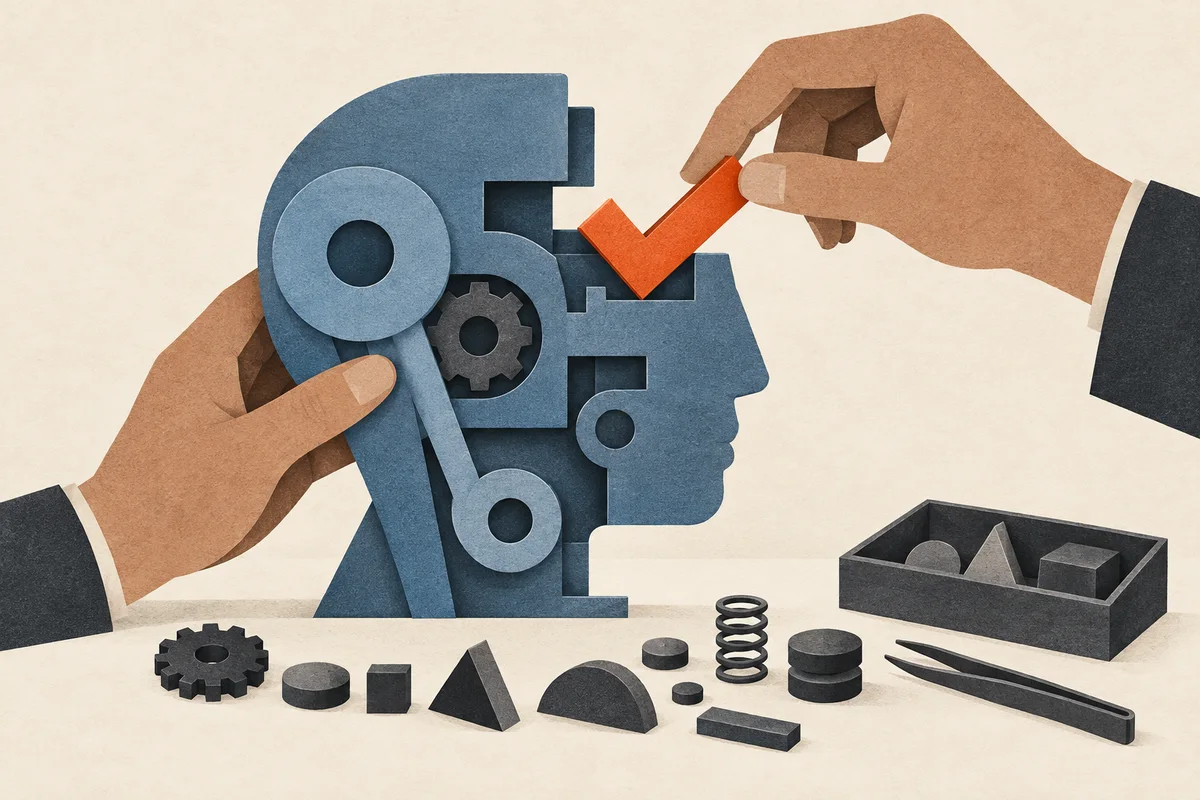
This week's question: what does human review establish?
This edition covers October 26–November 1 through 07:07 Singapore time on November 1. It synthesizes our three News articles from the week and adds context from OpenAI's October 26 task-data release. Our interpretation is that a useful discussion of AI at work needs separate evidence about opportunities to enter a job, the choices made inside it and the work people are willing to delegate.
Hiring: a slowdown does not establish its cause
Statistics Canada's October 28 study finds youth hiring declines across occupational AI-exposure groups, generally beginning before ChatGPT. For ages 15–29, rates in high-exposure, high-complementarity jobs moved from 2.9% to 2.5%; high-exposure, low-complementarity jobs from 3.2% to 3.0%; and low-exposure jobs from 4.0% to 3.3%. Hiring means one-month tenure as a share of employees. These are seasonally adjusted six-month averages ending November 2022 and August 2026. The Labour Force Survey analysis covers paid employees aged 15–64 in ten provinces. Potential exposure is not measured adoption, and the descriptive comparison does not isolate an AI effect.
Sources: Statistics Canada
Analysts: an agent's preference can shape a choice
Anthropic's October 27 experiment gave agents hidden, randomized preferences while 50 AI-using analysts assessed synthetic farming data. Across four analytical decisions, choices matched the agent's assigned preference 86% of the time. Both options were defensible. The experiment used one task and Claude Opus 4.8, with deliberately amplified preferences. The direct final-policy effect was not statistically significant under the registered primary estimator. Eleven participants who declined AI were self-selected, so comparisons do not establish productivity benefits. Registration followed the start of collection; exact fieldwork dates were not established. No employment outcome was measured.
Sources: Anthropic — How AI agents shape experts' judgment calls; Anthropic — Research paper: Who's Aligned to Whom?
Public preferences: review is distinct from autonomy
Pew's October 29 report found 52% of US adults open to AI translating for a patient who does not speak English with human final review, versus 26% without review. Another 12% were not open to AI and 10% were unsure. The June 22–28 probability-based American Trends Panel survey had 3,488 respondents overall; these task questions went to a randomly assigned Form 1 subsample of 1,751, with weighting within form. These are preferences, not evidence that a review improves translation, creates interpreter jobs or meets a professional standard.
Sources: Pew Research Center — Americans Are Open to AI in Healthcare, but Want Humans Making Final Calls; Pew Research Center — Survey methodology; Pew Research Center — Survey topline and question bases
Usage: a broader task mix does not count jobs
OpenAI's October 26 Signals release maps consumer ChatGPT work messages to 165 activities from Q1 2025 through Q3 2026. Across 74 countries observed throughout, the average share in each country's ten most common activities fell from 56.0% to 51.1%. These are model-classified message shares, not workers or completed tasks. The underlying global sample is one million messages per month from accounts declaring ages 18 or older; enterprise, Codex, deleted accounts and training opt-outs are excluded. Privacy noise and small-group suppression apply, and version 3 restates earlier periods with a larger sample. It does not measure employment effects.
Sources: OpenAI — ChatGPT's expanding world of work; OpenAI — Signals version 3 data dictionary accompanying the October 26 release
Our interpretation: leave a decision someone can examine
Consider an invented team preparing an application for a community grant. Before drafting, each reviewer privately writes the two facts they think matter most and one reason the application might fail. After reviewing an AI-assisted draft, they compare those notes with the final argument. The exercise makes it possible to discuss where a view changed and why, rather than treating a signature as the whole record of review.
For someone building a portfolio, the artifact could be a short account of a disagreement: the initial view, the evidence that challenged it and the final decision. For a team evaluating an AI workflow, a useful question is who has time and authority to investigate that disagreement. These are our proposed exercises, not interventions tested by the sources above or evidence of a hiring advantage.
The week's findings should not be added into a total of jobs created or lost. They describe different populations, time periods and units: employees entering jobs, analysts making choices, adults expressing preferences and messages classified into activities. Keeping those distinctions visible makes the next question more useful: what would we need to observe to know whether this particular change is helping?
Sources & method
AI-generated weekly synthesis checked against primary sources through November 1 at 07:07 Singapore time. Publication dates differ from observation periods. We did not rerun experiments, reproduce the usage dataset or estimate employment effects. The grant example and proposed exercises are original editorial interpretation.
- Hiring and job separation rates in the era of generative artificial intelligence: Early evidence Statistics Canada ·
- How AI agents shape experts' judgment calls Anthropic ·
- Research paper: Who's Aligned to Whom? Anthropic ·
- Americans Are Open to AI in Healthcare, but Want Humans Making Final Calls Pew Research Center ·
- Survey methodology Pew Research Center ·
- Survey topline and question bases Pew Research Center ·
- ChatGPT's expanding world of work OpenAI ·
- Signals version 3 data dictionary accompanying the October 26 release OpenAI ·
Drafted and source-checked by Codex AI agents. Read our sourcing, illustration, and correction policy.
Explore the occupations
What could this mean for your work?
See task exposure and potential career moves for roles connected to this story.