of US jobs mapped to occupations likely to reorganize in its transition framework, not necessarily disappear. Source
2026 brief
AI workforce displacement is a task transition problem
The public debate often asks whether AI will replace jobs. The better operating question is which tasks move to software, which tasks become more valuable, and how quickly workers can transition.
Apply the research
What does this mean for your job?
See your role’s AI exposure and compare career paths by skills, pay and training time.
of occupation-specific messages in its sample crossed traditional job-task boundaries. Source
of occupations in pooled Claude usage saw AI used for at least one quarter of tasks before success weighting. Source
net jobs projected globally by 2030 after large creation and displacement flows.
workers are in occupations with some generative-AI exposure.
additional US occupational transitions may be needed by 2030.
Evidence audited 28 August 2026. Product-usage studies are directional early signals and are not representative employment forecasts. Review sources and limitations.
The landscape
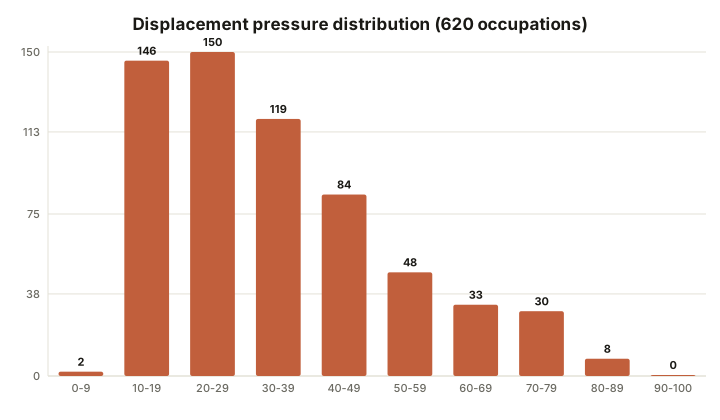
Displacement pressure across 620 tracked occupations
The distribution is the story: a long left shoulder of roles AI will mostly assist, and a red tail of roles where repeatable digital work is already exposed.
Each bar counts the occupations in a 5-point displacement-pressure band. Red bars mark scores of 70 or higher. The dashed line marks the median of 30 across all tracked roles.
Executive takeaways
- AI exposure is broad, but displacement pressure is concentrated in repeatable task bundles.
- Augmentation-heavy roles still need redesign because entry-level tasks can be automated first.
- Transition planning should start before layoffs, while adjacent roles are still available internally.
- The strongest programs combine worker voice, task audits, wage protection, and manager training.
Model snapshot
Displacement pressure varies by category and task mix
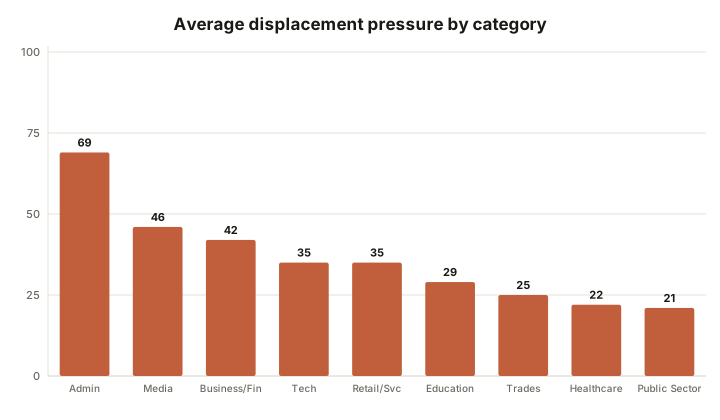
The charts below summarize the current public occupation seed model. They are not labor-market forecasts; they show how task exposure, automation pressure, augmentation, and transition feasibility differ across role groups.
Average pressure by category
Automation vs augmentation
Administrative
58/32
Media and Communications
35/55
Business and Finance
34/61
Technology
29/64
Retail and Service
26/37
Education
22/60
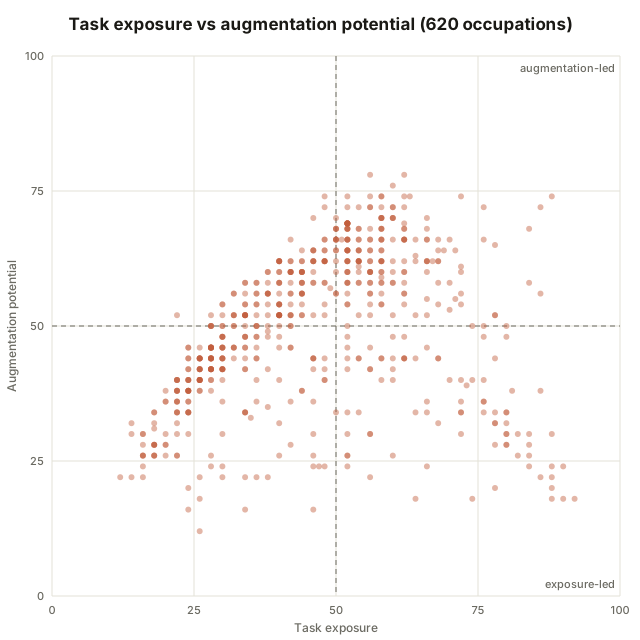
Exposure vs augmentation — every published occupation
Very high riskHighModerateLow
Each dot is one of the 620 tracked occupations. Roles to the right are the most exposed to current AI systems; roles higher up are the ones where AI is most likely to assist rather than replace.
Download the data and charts
Everything on this page is generated from the public occupation seed model and is free to reuse with attribution. The print view is optimized for your browser's Print → Save as PDF flow.
- 2026 brief (Markdown) — headline findings and role lists.
- Chart data (CSV) — all published occupation scores.
- Print-ready report view — charts and tables formatted for PDF export.
- Pressure distribution chart (SVG) — histogram across all occupations.
- Highest-pressure roles chart (SVG) — top 15 by displacement pressure.
- Category averages chart (SVG) — mean pressure by work family.
- Exposure vs augmentation chart (SVG) — scatter of all occupations.
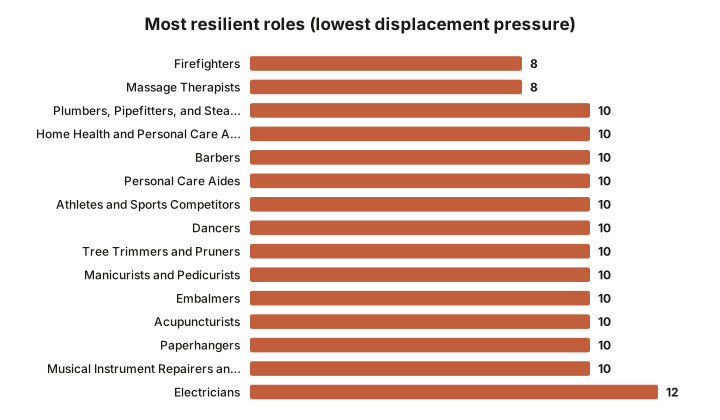
- Most resilient roles chart (SVG) — 15 lowest-pressure roles.
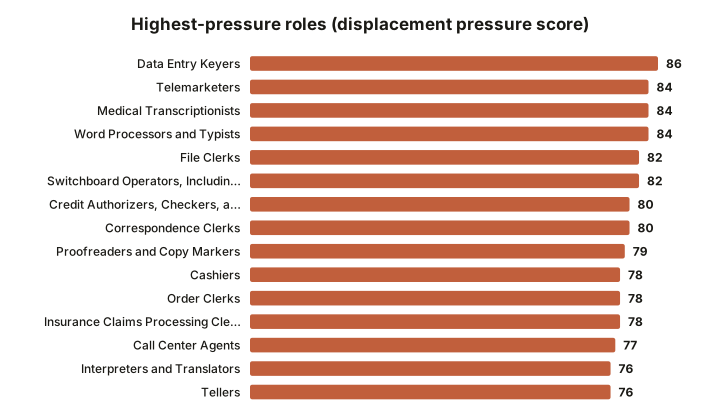
Highest-pressure roles in the current model
RolePressureAutomationTransition fit
Data Entry Keyers8678%58%Telemarketers8474%60%Medical Transcriptionists8476%60%Word Processors and Typists8478%60%File Clerks8272%62%Switchboard Operators, Including Answering Service8274%60%Credit Authorizers, Checkers, and Clerks8072%62%Correspondence Clerks8074%62%Why displacement is uneven
AI workforce displacement does not follow job titles cleanly. It follows task bundles. A job can be highly exposed to AI because it includes writing, summarization, classification, lookup, analysis, or routine customer interaction. That does not automatically mean the whole occupation disappears. It means the work can be decomposed, redesigned, and repriced.
The highest-risk roles tend to combine repeatable digital inputs, low switching costs, limited regulatory protection, and weak wage buffers. More resilient roles tend to include physical context, accountable judgment, social trust, licensing, live coordination, or environment-specific decision-making. The middle is where most workers sit: jobs that will not vanish overnight, but will change quickly enough that waiting is the risky choice.
Exposure, automation, and augmentation are different signals
Exposure means AI can touch a task. Automation means the task can plausibly move from a worker to software after process integration. Augmentation means a worker can use AI to complete the task faster, with better coverage, or at higher quality while retaining accountability. A serious workforce plan keeps these signals separate.
This distinction matters for policy, education, and individual career planning. A role with high exposure and high augmentation may need tool training and redesigned entry-level pathways. A role with high exposure and high automation may need faster transition support, wage protection, and adjacent-role matching. A role with low exposure may still need digital fluency because surrounding workflows will change.
What workers should do first
The practical move is to audit tasks before choosing a course. Workers should list the parts of their job that involve drafting, lookup, summarization, handoffs, scheduling, classification, reporting, and quality checks. Those tasks are the first candidates for automation or augmentation. The next question is which higher-value responsibilities remain: client context, escalation, compliance, physical service, stakeholder trust, technical judgment, or workflow ownership.
A good transition plan protects wage and identity. The fastest path is rarely a total career reset. It is often an adjacent move that reuses domain knowledge while adding data fluency, AI workflow supervision, customer success, operations analysis, compliance, project coordination, or hands-on credentialed work.
What employers should do first
Employers should avoid treating AI adoption as a pure software rollout. The better first step is a task map: identify which tasks are repetitive, which require human review, which create legal or customer risk, and which are entry-level learning pathways. Removing early-career tasks without replacing learning opportunities creates long-term capability gaps.
The strongest programs pair AI deployment with internal mobility. That means publishing role redesigns, funding short training paths, giving managers guidance on job redesign, and measuring whether productivity gains are creating better work or simply reducing headcount.
Roles most exposed in 2026
The most exposed roles are not always the roles with the highest public anxiety. They are the roles where work already arrives in digital form, where outputs are standardized, and where quality can be checked through rules or sampling. Data entry, routine bookkeeping, scripted support, basic content production, translation, intake, scheduling, document review, and repeatable research all have high exposure because AI systems can operate directly on the inputs.
Exposure becomes displacement pressure when the business case is simple. If a task is frequent, measurable, low-risk, and expensive at human scale, employers have a stronger incentive to automate it. If a task is regulated, trust-heavy, physical, ambiguous, or tied to customer retention, employers are more likely to keep a human accountable and use AI as assistance.
Why entry-level work needs special attention
Entry-level work often contains the tasks that AI can handle first: drafting, formatting, checking, logging, summarizing, searching, and producing first-pass analysis. Removing those tasks may look efficient in the short term, but it can weaken the career ladder. Workers learn judgment by doing simpler tasks first, seeing exceptions, and receiving feedback from more experienced colleagues.
A better AI adoption plan redesigns early-career work rather than erasing it. New workers can review AI output, investigate exceptions, document workflow failures, build datasets, support customers, test assumptions, and learn how decisions are made. That keeps the learning pathway alive while still using AI to reduce repetitive production work.
What educators and training providers should build
Training providers should focus less on generic AI literacy and more on transition proof. A useful program should help a worker pick a target role, map transferable skills, complete a small work sample, and explain the result to a hiring manager. Workers do not need another abstract certificate if it does not connect to a job posting, wage target, or portfolio artifact.
The strongest short programs will combine domain context with practical tools: spreadsheet validation for administrative workers, CRM and retention workflows for service workers, compliance documentation for finance and legal workers, AI review protocols for writers and analysts, and workflow mapping for operations roles. Training should be short enough to start before a worker is displaced and specific enough to show immediate evidence.
How policy should respond
Policy responses should not wait for mass unemployment statistics. By the time displacement is obvious in headline numbers, workers may already have lost bargaining power. Better indicators include task redesign, hiring freezes in entry-level roles, declining hours, increased monitoring, contractor substitution, and widening wage gaps between workers who can supervise AI workflows and workers stuck in automatable tasks.
Public programs can help by funding short transition pathways, publishing local demand data, supporting wage insurance pilots, expanding career navigation, and requiring transparency when AI systems materially reshape work. The goal is not to stop productivity tools. The goal is to make sure workers can move with the work instead of being surprised by it.
How to read displacement.ai scores
The scores on displacement.ai are planning signals. They intentionally separate task exposure, automation, augmentation, wage vulnerability, transition feasibility, and source confidence. A high score should prompt a worker to make a plan. A low score should not create complacency, because surrounding workflows can still change. The useful question is always practical: what should this person do next with the time, skills, wage needs, and local market they actually have?
This is why each occupation page includes adjacent pathways and upskilling priorities. Ranking risk without a next move is fear content. Ranking risk with salary fit, training runway, and transition actions can become a planning tool.
Signals to watch over the next year
The most important early signals will appear before official employment data confirms a trend. Watch for job descriptions that merge two roles into one, postings that require AI tool fluency for formerly entry-level work, reduced hiring for junior analysts or coordinators, and new quality-review roles that supervise automated output. These are signs that work is being redesigned even if headcount has not yet fallen.
Workers should also watch internal signals: fewer routine assignments, more pressure to produce with smaller teams, new software that handles intake or drafting, and managers asking people to validate machine-generated work without changing job titles. Those changes often precede formal restructuring. The right response is to document new responsibilities, turn AI-assisted work into measurable outcomes, and build evidence for the next role before the current role is formally rewritten.
What a good transition metric looks like
A useful transition metric should combine risk with feasibility. A role can be highly exposed but still offer a strong transition path if the worker has domain knowledge, customer context, compliance experience, or technical fluency that carries into nearby roles. Another role can look safe in the abstract but be impractical for a specific worker if it requires years of schooling or a major wage reset.
This is why displacement.ai emphasizes salary fit, skill overlap, training runway, and resilience together. The best next move is not always the lowest-risk occupation. It is the path that a worker can realistically start now, prove within weeks, and use to preserve income while moving toward work that is harder to automate.